To start at the beginning...
Popular opinion/belief is that Noah took animals on the Ark "two by two".
Genesis 7:2:
You must take with you seven of every kind of clean animal, the male and its mate, two of every kind of unclean animal, the male and its mate,
The list of clean vs unclean animals is found in Leviticus 11 and Deuteronomy 14. I'm not going to include the full text here [I encourage you to read them for yourself], just the close of Leviticus Chapter 11.
Leviticus 11:
45 for I am the LORD who brought you up from the land of Egypt to be your God, and you are to be holy because I am holy.
46 This is the law of the land animals, the birds, all the living creatures that move in the water, and all the creatures that swarm on the land,
47 to distinguish between the unclean and the clean, between the living creatures that may be eaten and the living creatures that must not be eaten.'"
So we have a definition of food; or creatures which may, or must not, be eaten. There is generally little to no controversy on the plants as food defined back in Genesis. Though I will note that the idea of a plant-only diet would appear to only have support within the context of Eden. The mention of Cain and Abel's sacrifices would indicate that God's Law(s) [enumerated later in His Word] had been known to them. Furthermore, if we look into the sacrifices we see that in most cases some portion was eaten.
Exodus 29:33:
They are to eat those things by which atonement was made to consecrate and to set them apart, but no one else may eat them, for they are holy.
Leviticus 7:15:
The flesh of the sacrifice of his peace offerings for thanksgiving shall be eaten on the day of his offering. He shall not leave any of it until the morning.
16 If his offering is a votive or freewill sacrifice, it may be eaten on the day he presents his sacrifice, and also the leftovers from it may be eaten on the next day,
Deuteronomy 14:23:
You shall eat before the LORD your God, in the place which he shall choose, to cause his name to dwell there, the tithe of your grain, of your new wine, and of your oil, and the firstborn of your herd and of your flock; that you may learn to fear the LORD your God always.
I'll go into the tithe thing seperately. But isn't that an interesting verse that is rarely, if ever, mentioned in church?
Back to Noah... He would have known which animals were clean (food) and which were unclean (not food), just as Cain and Abel knew of God's laws for their sacrifices.
But... but... That was the 'Old Law/Testament'... Jesus 'did away' with that... We're not 'under that law'.... etc. etc.Ecclesiastes 1:9:
What exists now is what will be, and what has been done is what will be done; there is nothing truly new on earth.
Some of these types of 'arguments' can seem kinda silly once you understand just how much of what is said in the New Testament is not really 'new' and is more of a mirror; a reiteration.
I Peter 1:24:
For all flesh is like grass and all its glory like the flower of the grass; the grass withers and the flower falls off,25 but the word of the Lord endures forever. And this is the word that was proclaimed to you.
Peter is quoting from Isaiah (v40:8).
1 Samuel 15:29: The Preeminent One of Israel does not go back on his word or change his mind, for he is not a human being who changes his mind."
Numbers 23:19: God is not a man, that he should lie,
nor a human being, that he should change his mind.
Has he said, and will he not do it? Or has he spoken, and will he not make it happen?
This concept of His Word being eternal / never changing His mind, is repeated throughout the Torah/Law in verses including statements like:
Everlasting Covenant
Throughout your generations
Ordinance forever
So where does modern Churchianity get this contradictory idea that God changed His mind regarding His Law??
Matthew 5:17:
"Do not think that I have come to abolish the law or the prophets. I have not come to abolish these things but to fulfill them.
Matthew 5:18:
I tell you the truth, until heaven and earth pass away not the smallest letter or stroke of a letter will pass from the law until everything takes place.
Matthew 5:19:
So anyone who breaks one of the least of these commands and teaches others to do so will be called least in the kingdom of heaven, but whoever obeys them and teaches others to do so will be called great in the kingdom of heaven.
Deuteronomy 4:2:
Do not add a thing to what I command you nor subtract from it, so that you may keep the commandments of the LORD your God that I am delivering to you.
On that note, let's look at something that is added into many translations.
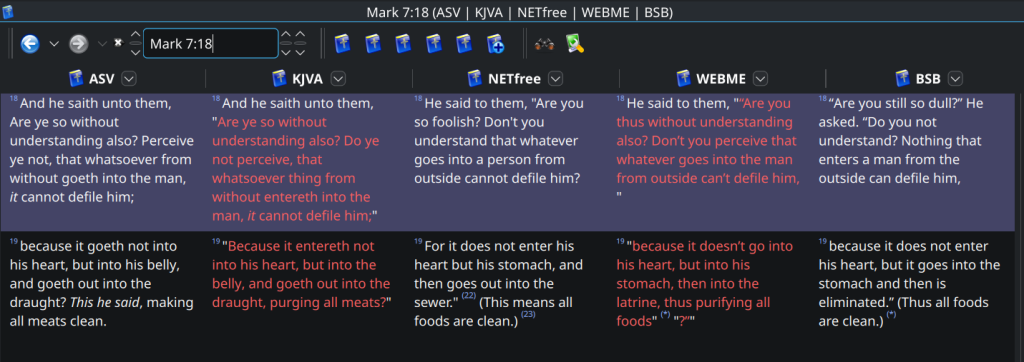
There remains some debate as to whether or not the parenthetical statement at the end of Mark 7:19 is added text since it doesn't appear in the earliest Greek manuscripts and seems to be a translation footnote which does not really fit the context. At best it's simply misinterpreted/misapplied; at worst, it's an outright deception. There are several analyses of this elsewhere online so I'll not dig into the technicalities here.
My screenshot above includes a few translations. One thing to note is the reference to "food" or "meats." The specific question posed by the Pharisees and Scribes was about eating with unwashed hands (v.5) [Note also: in the text of Matthew 15 the Greek would translate to "when they eat bread" so the subject of animals/meat being part of the explanation doesn't really fit]. According to their rules (eg. temple service purity rituals, Lev. 7 et.al. being applied to situations outside the temple or similar such over/mis-applications of Torah/Law) unwashed hands would make the food 'unclean'.
Additionally, the general context here is Yeshua/Jesus addressing "teaching as doctrine the commandments of men." It seems quite ironic that a verse in this context is often used as a justification for the notion that God changed His definition of food - an apparent man-made belief common to dispensational and replacement theologies.
The Pharisees/Scribes certainly weren't questioning that the disciples were eating things which were not considered food (as noted it was likely just bread). That sort of blatantly obvious Torah violation would have been quite a huge deal and certainly of much greater offense than mere ritual cleanliness. So to apply a modern english definition of food or meat - that being any substance which might be consumed presumably for some nutritional value - in order to use Mark 7:19 as some type of 'proof' that Yeshua/Jesus was declaring that all animals were henceforth acceptable as food is quite a leap and simply disingenuous. Scratching itching ears, if you will.
Or maybe I'm just being as daft as Peter, who in Acts 10 just forgot that Yeshua/Jesus 'did away with' (or 'fulfillled') the Law which meant he was free to ignore it with impunity, and he had to be reminded that he could now and forevermore eat anything.
...But probably not, as we can see that Scripture doesn't say that happened or that the Apostles had any such delusions of the sort, as claimed by most of modern Churchianity.
Acts 10:14:
But Peter said, "Certainly not, Lord, for I have never eaten anything defiled and ritually unclean!"
This is another 'proof text' used to justify the Churchian redefinition of food that really makes even less sense logically. If the Word (Yeshua/Jesus) had declared all animals food in Mark 7:19 (ie. eliminated the distinction between 'clean' and 'unclean' creatures), why would Peter (who was there...
Matthew 15:15:
But Peter said to him, "Explain this parable to us."
) have any such objection at this point in Acts? Whether all the animals in the sheet (or net) were unclean or, as the text and Peter's reply would suggest, there were "all kinds" of animals - clean and unclean. Common (defiled and/or 'ritually unclean' as the NET uses), rather than just unclean, may be a closer translation for a nuanced word study but I won't go down that rabbi trail here.
In any case, we should expect Peter to respond with something like
Cool thanks Lord for providing the feast, think I'll just have the lobster with bacon-wrapped lion filet surf & turf; now what are you trying to teach me Lord?
if he had any shred of belief that Yeshua had ever said or taught them that the "law of Moses" in general, or specifically the part about "food", no longer mattered since His ministry or even after He was crucified - just 'ya know, love the Father and be excellent to one another - cya on the other side dudes, it'll be awesome!!!...' Surely Peter would've known that simply being thankful and praying for the Lord to bless the 'food' made it magically clean/kosher. No? The defiled or ritually unclean wording would be pointing to the concept that merely touching "unclean" would make the otherwise clean = unclean or "common" and that's really the point here.
Leviticus 7:19
The meat which touches anything ceremonially unclean must not be eaten;
...
21When a person touches anything unclean (whether human uncleanness, or an unclean animal, or an unclean detestable creature) and eats some of the meat of the peace offering sacrifice which belongs to the LORD, that person will be cut off from his people.
The vision's meaning is explained rather clearly in Chapter 10 and it has nothing to do with food, per se. Again it has to do with traditions or "commandments of men" being equated to doctrine (God's Law).
Acts 10:28:
He said to them, "You know that it is unlawful for a Jew to associate with or visit a Gentile, yet God has shown me that I should call no person defiled or ritually unclean.
So this account also cannot support changing the definition of food - "
living creatures that may be eaten and the living creatures that must not be eaten".
Quite simply, there is no Scripture where YHWH changed His definition of what is, and is not, food. It remains the same as it's always been; and if we consider verses in Isaiah 66 which most, if not all, of Churchianity considers to be end-times judgment prophecy, His definition of food will be the same until the end.
Isaiah 66:17 "As for those who consecrate and ritually purify themselves so they can follow their leader and worship in the sacred orchards, those who eat the flesh of pigs and other disgusting creatures, like mice - they will all be destroyed together," says the LORD.
I suppose there's the whole "so what, if Jesus didn't change the definition of food? and even extra-biblical evidence shows that the Apostles and 1
st Century christians all continued to observe Shabbat, the Feasts, food laws, etc. - they were just keeping up appearances for the jews or something... the OT law still doesn't apply anymore, well except for the 10 Commandments, and marriage/adultery/homosexuality laws (depending on denomination), and church tithes..." type arguments which I haven't addressed here.
OK, well... Most of the general 'God/Jesus did away with His Law' claims rely on verses from Paul's letters - which should all be considered with Peter's warning in mind...
2 Peter 3:15:
And regard the patience of our Lord as salvation, just as also our dear brother Paul wrote to you, according to the wisdom given to him,
16 speaking of these things in all his letters. Some things in these letters are hard to understand, things the ignorant and unstable twist to their own destruction, as they also do to the rest of the scriptures.
It could be said that Paul had a PhD level of education and knowledge in the Scriptures, so discussion or analysis involving verses/passages from his letters can get pretty deep. As such I've also left the Romans 14 and 1
st Timothy 4 'Churchian proofs' for another article/post.
Aside from the wisdom and instructions found in the OEM specs and Operating Manual (aka God's Word), science continues to reveal how unhealthy it is to consume non-food creatures. Modern cooking methods, sometimes used as a justification of why it was bad in ancient times but it's all good to eat those things now, cannot overcome certain toxins and other biologically detrimental effects that come from eating non-food species. I'll just quote from a couple older studies here in closing.
Toxins responsible for most shellfish poisonings are water-soluble, heat- and acid-stable, and are thus unaffected by ordinary cooking methods. - "Shellfish Toxicity"; Author: Thomas C Arnold, MD, FAAEM, FACMT
The early blood coagulation and clotting observed after consuming cooked unmarinated pork are adverse changes in the blood. A shorter blood coagulation time is associated with increased systemic biochemical inflammation as well as the possible formation of blood clots in the body, as in heart attack or stroke. This condition in the blood, if chronic, is associated with increased risk of chronic degenerative disease, including cardiovascular disease, cancer, autoimmune disorders and others. - Rubik B (2009) Pilot Research Study;...
Scripture Reference Version/Translation spoiler
I quote from the New English Translation, unless noted otherwise.