There seems to be a spirit or attitude that comes up when the average christian is challenged on their obedience to God's Law.
The typical retort is a regurgitation of Church dogma about the OT laws being "legalism", "done away with", "only for the jews", and "we're under grace not under the law", etc.
Generally, church theologies put the Torah/Law into categories of "moral", "civil", and "ceremonial", though there are no such biblical distinctions.
Most of the so-called moral laws they still consider valid. [some removed, some added]
Certain civil laws are considered still applicable, while others definitely are not, and some are just viewed as general guideline 'good ideas' to try to follow.
The ceremonial laws, and anything vaguely related, are right out.
...Well... except for tithe - in that case the Levites are replaced with the Church (and pastor/leadership) and if you're not tithing to the church you're robbing God... A topic for another post/article.
Practically all health/safety/cleanliness laws (sometimes their own category, otherwise lumped into civil and/or ceremonial) are also viewed as obsolete.
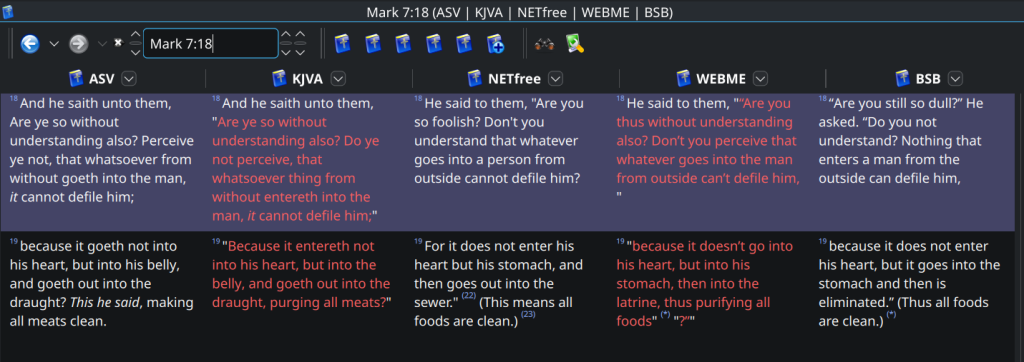
Why are 'food laws' thrown out again? Is it simply because animals are part of the sacrificial/ceremonial system? Or have I missed the verses where Yeshua teaches the Apostles that something in the biology of the human body and/or animals changed sometime between the birth and resurrection of the Messiah that makes any health (or other) reasons for such laws obsolete?
Based on my analysis, the so-called food laws appear to be more of a definition of what is, or is not "food" than anything else. Two of the most popular passages that Churches misuse in order to say that He eliminated any distinction between
"living creatures that may be eaten and the living creatures that must not be eaten" I address in
"Did Jesus/Yeshua change how He defined food?" As I point out there, Isaiah 66 (end-times prophecy) would be an indication that 'food' doesn't change (v.17), and neither does the Sabbath (v.23).
His Commandments (Laws) regarding His Feasts appear to be tossed out with the ceremonial bath water.
Somehow this also includes the weekly Sabbath, while the rest of the Big 10 are still basically considered to be in effect. The Catholic version of the 10 Commandments changes that one to a simple "Remember to keep holy the LORD's Day" and interestingly removes idolatry from the list arguing that it's just implied by 'no strange gods before me.' The protestant denominations (almost all other modern churches) inherited this Sabbath change to Sunday thing which basically comes from Constantine-era Roman unification efforts (grouping pagan, Christian and other various holidays/feasts together) along with some early church anti-semitism. Many years ago, I co-authored a study on the Sabbath which goes into some of those details, maybe at some point I'll make it available here.
Some churches even propagate a "every day [or any day] is the Sabbath" nonsense idea that has no real scriptural, or logical, basis whatsoever. The Roman unification, pagan holiday co-opting stuff is also part of the replacement/elimination of His Feasts with things like Christmas and Easter.
"Which came first, the made up 'Christian holidays' or the coinciding pagan festivals?; And who melded all the symbology/imagery/etc.?" is still a point of debate.
Aren't there at least a couple verses about "mixing the holy and the profane"?
Like this one:
2nd Corinthians 6:17 - Therefore "come out from their midst, and be separate," says the Lord, "and touch no unclean thing, and I will welcome you,
18 and I will be a father to you, and you will be my sons and daughters," says the All-Powerful Lord.
So, why any church which calls itself "Christian" insists on continuing such practices is really beyond me.
Alright, so I've pointed out a few sacred cows. This is more of an overview on modern Churchian attitudes on the Law and obedience so I'm trying to not dive too deep into specifics.
Let's start with the cherry-picked phrase from Romans 6:14 "Christians are under grace, not the law", and the "Jesus did away with (or fulfilled) the law - so we don't have to follow it" attitude which is typically associated with the idea that obedience to His Law equals being legalistic as a path to salvation (or equals "saved by works"). While individual opinions on some of the specifics are all over the place, this is the most common general line of thinking.
Where does this concept originate?
It quite likely comes from the same (~1700 year old or so) early church anti-semitism involved in changing the Sabbath to Sunday.
While there seems to be certain sects of Judaism being addressed in the NT that believed in obtaining God's salvation through "works" only or mere ritual obedience; was this really a majority opinion?
Salvation was always by grace through faith. We see this in reference to Abraham (Romans 4:3, quoting Gen 15:6). Also in Hebrews 11, I Samuel 15:22-23, Micah 6:6-8, and others.
Whereas certain groups within Judaism added rules in an attempt to keep people from coming close to breaking His Laws, Modern Churchianity seems to have taken the opposite extreme.
It's like the man that asked "What must I do...?"
And Buddy Jesus said "Do you believe in me?"
The man replies "Totally! For sure dude"
Thusly, Buddy Jesus said "Well alright! Sweet! That's it man! Cya on the other side."
Based on what many believe, it would seem that this was the basic doctrine they were taught - minus the surfer lingo of course, at least in most cases. ;)
But that's not what Yeshua/Jesus said at all, is it?
In the account of the rich young man/ruler (Matt 19:16) there doesn't seem to be an issue with his basic obedience to God's Laws. The problem is with his faith, and full obedience. There is a mirror of the 'Two Greater Commandments' (1. Love God 2. Love your neighbor) here. Interestingly, "love your neighbor as yourself" (v.19) is not specifically stated in the 10 Commandments. It is in Leviticus 19:18 though, after several specific commandments reflecting that basic theme. In any case, the commandments which the man states he has followed since his youth are those falling under the "love your neighbor" category. Whereas Yeshua/Jesus seemingly points out that the man is still missing something in the "love God" category. The general speculation from the context is that his love of money is greater than his love of God - basically that money/wealth is his idol or god which he is unwilling to give up worshipping.
Certainly that is part of it, but looking through a modern cultural lens here; if the man knew of the commandments in order to ask "which ones?" I would think he might at least question why selling everything and giving to the poor would be necessary if that was just for icing on the cake, so to speak (treasure in heaven). Or at least respond with a "well I have treasure here, I don't really care whether I have it in heaven. I just want to know how to get there. So about this following you business..." He doesn't even try bargaining as one might expect a rich person, particularly a ruler, to do. Another thought here is that the man likely gave
something to the poor and figured he was at least 'ok' on that point. The term Treasure in heaven was usually associated with the practice of almsgiving which was at least somewhat common. This seems to indicate that the 'following' part was the real issue, not necessarily the money itself.
So we can assume that he knows the Torah, or at least what the religious leaders say are law (commandments), but realizes one or both of the following:
a) not every 'law' which is taught is actually from God - some are man-made
b) there must be something more than simply 'being a good person' and just obeying the commandments.
An interesting part is that the "hard for a rich person to enter the kingdom of heaven" statement even caused the disciples [not necessarily the 12, possibly other followers present] to question, "Then who can be saved?" They were following and likely had given up any wealth they had. So why would they question?
Were they just thinking in earthly terms such as; the rich have been blessed by God so they must be doing everything right... and they aren't shoe-ins for eternal life?!?! ?
Peter also questions - "Look, we have left everything to follow you! What then will there be for us?" Now, Peter's question appears to have more to do specifically with the 'treasure' in heaven part, so it seems like he understood the distinction and he just wanted to know that giving up their earthly things would have some kind of reward.
If we go to v.28 of Matthew 19, Yeshua says "you who have followed me"...
The greek translated as "follow" here is generally the same used in the Septuagint for the hebrew "walk after" (halak achar), which also may be translated as "follow" in English. For example:
Deuteronomy 13:3:
You must not listen to the words of that prophet or dreamer, for the LORD your God will be testing you to see if you love him with all your mind and being. 4You must follow the LORD your God and revere only him; and you must observe his commandments, obey him, serve him, and remain loyal to him.
The Greatest Commandment (Matt 22:37) mirrors this OT phrase (Deut 6:5) - 'Love the Lord your God with all your heart, with all your soul, and with all your mind.' This phrase is usually found along with following His Commandments or some list of specific Laws. So the 'follow' part involves a bit more than just tagging along. The young ruler wasn't ready to make that leap.
Most Church messaging will use this passage to reinforce the 'obedience to His laws = salvation by works' [the ruler was trying to 'buy' his way into heaven through "good works"] and/or to support the idea that just the laws Yeshua/Jesus specified, namely the 2 Greatest Commandments and by extension the 10 Commandments (or the 'moral law'), are the only ones that matter anymore. To go on a bit of a tangent... The really odd part to such messaging has to do with v.26 - "This is impossible for mere humans, but for God all things are possible." which is in opposition to this notion that it's impossible for us to keep "the law" = so He did away with it; or that He perfectly kept the law (fullfilled it) so we don't
really have to -
but should, kinda, ya know, make some effort to, and at least try to 'love your neighbor' and stuff, though it's totally cool if we don't. I will also throw in this tidbit here to think on; The Church tends to repeat often the "with God
*all things* are possible" as an absolute statement. What is usually left out is the caveat of God's nature and His Laws. Basically, He's not going to act against His Will or be the proverbial genie in a bottle.
So there's some contradiction problems here. Some of these sorts of so-called biblical contradictions are more a byproduct of things like Replacement and Dispensational Theologies and the related interpretational biases which try to justify their existence with convoluted explanations. In other words, deceptions of the enemy - "Is it really true that God said you must not eat...? Surely you will not die..."
If there appears to be a contradiction maybe the first thing we should consider is that our interpretation or the translation of the English might be wrong. Most English translations have at least some theological bias and sometimes even an accurate word translation fails to convey the full/accurate meaning, or how those words would have been originally understood.
The rather simple "all sin/fall short" sentiment itself falls short of being equal to "we can't keep all His laws, that's why He made them no longer required" or any similar line of thinking. Particularly when one considers that concept against His statements like "it is not too hard for you, neither is it far off" (Deut 30:11), "...through/with/for God all things are possible", and "His commandments are not burdensome" (1 John 5:3).
1 John 3:4 Everyone who practices sin also practices lawlessness; indeed, sin is lawlessness.
[KJV and others: lawlessness = transgression of the law]
God's laws are not burdensome, His yoke is easy, etc. yet churches insist they can't be followed, invent ways to sidestep, and even encourage not following them. There is little to no discernible difference between any secular group/organization and most modern churches. It's no wonder that society has so many problems.
Let's take a brief look at another common 'proof' of this "law is done away with (or fulfilled)" concept from Romans 10. At verse 4, "Christ is the end [fulfillment] of the law ..." full stop - is the cherry-picked section of this passage. Or at least that is the base simplistic understanding propagated as to it's meaning. At this point let's recall the closing remarks of Peter's 2
nd letter.
14 Therefore, dear friends, since you are waiting for these things, strive to be found at peace, without spot or blemish, when you come into his presence.
15 And regard the patience of our Lord as salvation, just as also our dear brother Paul wrote to you, according to the wisdom given to him,
16 speaking of these things in all his letters. Some things in these letters are hard to understand, things the ignorant and unstable twist to their own destruction, as they also do to the rest of the scriptures.
17 Therefore, dear friends, since you have been forewarned, be on your guard that you do not get led astray by the error of these unprincipled men and fall from your firm grasp on the truth.
18 But grow in the grace and knowledge of our Lord and Savior Jesus Christ. To him be the honor both now and on that eternal day.
You could say Paul gets quite deep, philosophically (or theologically) speaking, in Romans. At Chapter 7 he even includes a sort of disclaimer "for I am speaking to those who know the law". Being a "Pharisee of Pharisees", one might also say he was a 'Lawyer of Lawyers'. Paul's use of the word 'law' can be confusing since he refers to various 'laws'. I might compare it to a modern lawyer, maybe even a Supreme Court Justice, writing to colleauges wherein they use the general term 'law' but could be referring specifically to 'Case law', 'Common law', 'Constitutional law', 'Admirality law', 'Administrative law', Commercial law', 'Criminal law', 'State law', 'Federal law', etc. The lawyer would recognize the, often significant, differences based on their knowledge and the context, whereas the average person might read all the various references as merely 'the law'. I believe this is a substantial part of the "hard to understand" warning which Peter wrote of.
The 'righteousness by law' as mentioned in v.5 refers to Leviticus 18:5 "So you must keep my statutes and my regulations; anyone who does so will live by keeping them. I am the LORD." But the 'righteousness by faith' in v.6-8 ("the word of faith we proclaim") is a reference to Deut 30:12-14. Now go read both of those sections of scripture (Leviticus 18 & Deuteronomy 30) and find the difference between "the righteousness of/by the law" and "the righteousness of/by faith".
What's the difference? spoiler
There really isn't one. Paul is essentially referring to the same thing. The very subtle distinction between the two that Paul is making here has to do with the Messiah.
Romans 10:16:
But they didn’t all listen to the glad news. For Isaiah says, “Lord, who has believed our report?” (Isaiah 53:1)
17 So faith comes by hearing, and hearing by the word of God.
The contrast is Jew vs Gentile which we can see more clearly in the surrounding chapters (9 & 11).
Romans 9:30 What shall we say then? That the Gentiles, who didn’t follow after righteousness, attained to righteousness, even the righteousness which is of faith;
31 but Israel, following after a law of righteousness, didn’t arrive at the law of righteousness.
32 Why? Because they didn’t seek it by faith, but as it were by works of the law. They stumbled over the stumbling stone;
Paul is not saying that His Law has ended or that it 'no longer applies' in Romans 10:4, or anywhere else for that matter. He is basically making a "not seeing the forest for the trees" kind of point here. The whole "under grace; not under the law" concept as it is commonly used to argue that Christ "did away with the law" or God changed His Commandments is a fallacy.
Rom 3:31 - Do we then nullify the law through faith? Absolutely not! Instead we uphold the law.
Rom 7:12 - So then, the law is holy, and the commandment is holy, righteous, and good.
James 1:22
(NET) But be sure you live out the message and do not merely listen to it and so deceive yourselves.
(WEBME) But be doers of the word, and not only hearers, deluding your own selves.
John 14:15:
"If you love me, you will obey my commandments.
...
John 14:21:
The person who has my commandments and obeys them is the one who loves me. The one who loves me will be loved by my Father, and I will love him and will reveal myself to him."
John 14:22:
"Lord," Judas (not Judas Iscariot) said, "what has happened that you are going to reveal yourself to us and not to the world?"
John 14:23:
Jesus replied, "If anyone loves me, he will obey my word, and my Father will love him, and we will come to him and take up residence with him.
John 14:24:
The person who does not love me does not obey my words. And the word you hear is not mine, but the Father's who sent me.
Matthew 5:17 "Do not think that I have come to abolish the law or the prophets. I have not come to abolish these things but to fulfill them.
18 I tell you the truth, until heaven and earth pass away not the smallest letter or stroke of a letter will pass from the law until everything takes place.
19 So anyone who breaks one of the least of these commands and teaches others to do so will be called least in the kingdom of heaven, but whoever obeys them and teaches others to do so will be called great in the kingdom of heaven.
20 For I tell you, unless your righteousness goes beyond that of the experts in the law and the Pharisees, you will never enter the kingdom of heaven.
Why is there such a defiance to obeying even some of the simplest of His Commandments? Why does "the church", leadership, etc. put so much effort into the mental/semantic gymnastics required in order to justify willful disobedience?
There are enough warnings of the "I never knew you. Go away from me, you lawbreakers!" judgement variety (eg. "I am warning you, as I had warned you before: Those who practice such things will not inherit the kingdom of God!") to indicate that while salvation remains
available to all who believe (grace through faith),
obtaining that salvation is still dependent upon one's actions - free will -
Obedience.
"Faith without works is dead"...
"Be holy for I am holy"...
Hebrews 10:26 For if we deliberately keep on sinning after receiving the knowledge of the truth, no further sacrifice for sins is left for us,
27 but only a certain fearful expectation of judgment and a fury of fire that will consume God's enemies.
28 Someone who rejected the law of Moses was put to death without mercy on the testimony of two or three witnesses.
29 How much greater punishment do you think that person deserves who has contempt for the Son of God, and profanes the blood of the covenant that made him holy, and insults the Spirit of grace?
30 For we know the one who said, "Vengeance is mine, I will repay," and again, "The Lord will judge his people."
31 It is a terrifying thing to fall into the hands of the living God.
In v.30, Paul is quoting from Deuteronomy 32. The same sentiment is also found in several Psalms (50, 96, 98, & 135), Ezekiel (18:30 & 34:17), Isaiah, etc. Furthermore it is repeated in Romans 12 and at 2
nd Corinthians 5:10. Here I just want to point out the closing of Deut 32:
45 When Moses finished reciting all these words to all Israel
46 he said to them, "Keep in mind all the words I am solemnly proclaiming to you today; you must command your children to observe carefully all the words of this law.
47 For this is no idle word for you - it is your life! By this word you will live a long time in the land you are about to cross the Jordan to possess."
It does not seem to be the simplistic, almost naive, 'just sincerely believe, say the magic words, and bingo - you now have a get outta hell free card that never expires and is irrevocable, cya in heaven bro' message that much of churchianity preaches.
Mere belief and faith does not exempt anyone from His judgement. The "once saved, always saved" stance doesn't really have a leg to stand on.
Throughout scripture His covenants, promises, blessings, etc. are in "if...then" statements. "If you/(my people) will do XYZ, then I will..." They are conditional.
The curses or consequences of disobedience would also be the result of what some might call a 'natural law' or karma. Remember the caveat of God's nature and His Law, or order of how things work here on Earth/in life, that I mentioned regarding the "with God all things are possible" reference...
So how much disobedience of His Commandments/transgression of His Law/sin will result in hearing "I never knew you..."? Matthew 7:23 & 25:12
I'll take the false accusations of being legalistic over hearing "Go away, I never knew you."
Joshua 24:14
Now obey the LORD and worship him with integrity and loyalty. Put aside the gods your ancestors worshiped beyond the Euphrates and in Egypt and worship the LORD.
15 If you have no desire to worship the LORD, choose today whom you will worship, whether it be the gods whom your ancestors worshiped beyond the Euphrates, or the gods of the Amorites in whose land you are living. But I and my family will worship the LORD!"